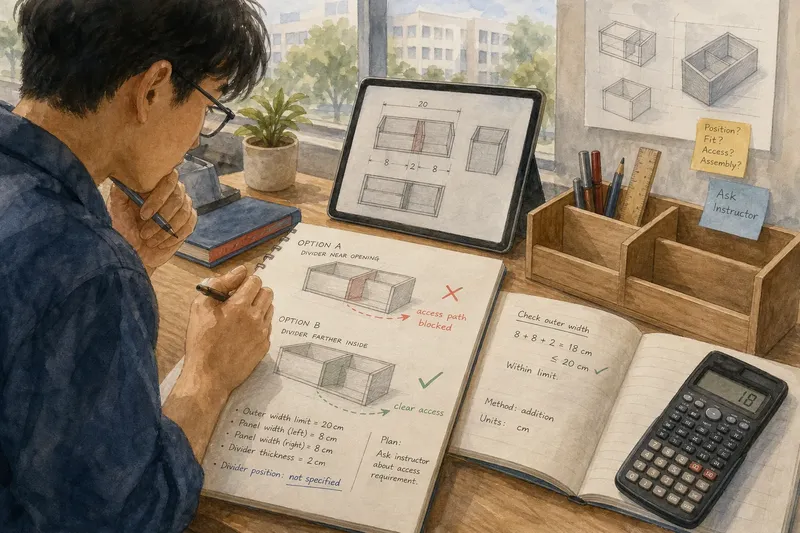
A Quiet Campus Study Session for One Difficult Concept
Plan a quiet campus study session around one difficult concept, choose a method that fits your learning gap, and leave with a clear next question.

You open a tutorial sheet at a quiet table on the Trường Đại học Bách khoa campus and notice that one diagram keeps slowing you down. A focused campus study session can turn that page into a specific explanation or a question you can take to class.
Start with the course material already in front of you. Choose one concept, then use the library, a group study area, or an instructor’s office hours according to the kind of support that concept needs.
Choose one course question
Write a narrow question at the top of your page: “What does this symbol represent?” or “Why does this diagram connect these components?” A broad goal such as “learn circuits” gives you no clear way to tell what needs attention.
Keep the relevant lecture slide, tutorial sheet, or notebook entry open. Use this quick decision list to pick a useful starting point:
- Observation: A term or symbol appears without a definition. If the course glossary explains it, copy the definition beside the symbol; if not, mark the page and prepare to ask a teaching assistant.
- Observation: A diagram’s labels or connections are hard to follow. If the original is legible, trace the relevant lines in pencil; if not, note which label or connection needs clarification.
- Observation: Two concepts seem to fit the same problem. If the course material gives conditions for each, compare them against the question; if a condition is missing, flag that gap instead of choosing by instinct.
- Observation: A worked solution skips a reasoning step. If you can name the rule used between the lines, write it in the margin; if you cannot, circle the first unexplained transition.
- Observation: You can follow the page but cannot explain the idea without looking. If you can state it from memory, try a related tutorial question; if not, return to the passage that supports your explanation.
- Observation: Several unrelated questions compete for attention. If one blocks the current task, work on that one; if none does, record the others and keep this session to the marked item.
Match the study format
Use the course material as a tool, not as a script to copy. The right format depends on what you can already explain.
Annotate a worked solution
Choose this when the method is unfamiliar. Beside each important line, write what it contributes: a definition, a condition, or a transformation. Stop at the first line you cannot justify, then compare that point with the lecture notes.
Complete a guided problem
Choose this when you understand the setup but lose the thread partway through. Cover one section of a worked solution or use a tutorial prompt, and fill in the missing reasoning before looking. If you get stuck, name the missing support—perhaps a definition, a sign convention, or a diagram connection.
Recall without notes
Choose this when you have reviewed the idea and want to see what you can produce unaided. Close the notes, explain the concept on a blank page, then compare your explanation with the course material. If you cannot begin, reopen the relevant passage rather than guessing.
Set up the campus space
A quiet library seat suits close reading and individual problem work. A designated group study area can suit discussion, as long as the space permits it and the conversation stays considerate of others.
Bring the materials tied to your question: the relevant slides, one tutorial sheet, a notebook, and a pencil. Add a calculator only if the task requires one. On a laptop or tablet, open the course files you need and close unrelated tabs.
For group work, put the same diagram or equation in front of everyone. When explanations differ, write down the exact point of disagreement and compare it with the instructor’s definitions. Confidence alone does not settle a technical question.
Work through a circuit question
Say you sit down with a hypothetical circuit tutorial sheet. It shows two components, and the printed solution assigns them the same voltage. Your starting materials are one diagram, one lecture note defining the relevant circuit relationship, one pencil, and no calculator because the question is about the diagram rather than arithmetic.
- Mark the claim. Circle the two components and underline the line assigning them the same voltage. The visible result is one claim to check, not an invitation to redo the whole sheet.
- Trace the connection. Follow the drawn lines with your pencil and write down the node labels you can read. If the labels establish a shared connection under the course’s definition, keep that observation; if they are unclear, mark the exact labels that need clarification.
- Compare the definition. Put the lecture note beside the diagram and compare its stated condition with the connection you traced. If the condition matches, write the definition beside the solution line; if it does not, record the mismatch as the unresolved question.
- Make the next decision. In this invented situation, suppose the labels are too faint to identify the connection. The result is one marked diagram and one question for a teaching assistant: “Which connection here establishes the voltage relationship?” If the labels were clear and the condition matched instead, the next task would be to explain that connection in your own words.
The worked example does not pretend to solve what the page leaves unreadable. It shows how the available materials determine whether you can explain the solution or need a specific clarification.
Ask a focused question
When you need help, point the instructor or teaching assistant to the exact course material and decision you cannot make. Mention the step you checked and the two possibilities you are weighing.
For the circuit sheet, you might ask: “Which connection in this diagram establishes the voltage relationship, and how does it match the lecture definition?” Bring the marked page to office hours or use the course’s approved discussion space.
Questions about campus study?
Where can I study on campus?
Use a library or quiet study area for solo reading, and choose a designated group space for discussion. Check the course notice for the location and format of office hours.
Should I study alone or with classmates?
Study alone when you need to read closely or explain an idea without prompts. Work with classmates when comparing interpretations helps, and make sure everyone is looking at the same course material.
What should I bring to a study session?
Bring the lecture material and problem sheet connected to your question, plus a notebook and pencil. Take a calculator only if the task calls for one.
What if my notes do not answer the question?
Mark the exact line, symbol, or diagram feature that remains unclear. Ask an instructor or teaching assistant about that point rather than restarting the entire topic.
Keep the next move visible
Before you pack up, write one sentence stating what the course material supports and one question, if any, that remains open. That note gives your next session a clear starting point.
A campus study session for one difficult concept does not need to end with a finished problem. It should leave you able to explain the next move: continue with a related question, or bring a precisely marked page to someone who can clarify it.